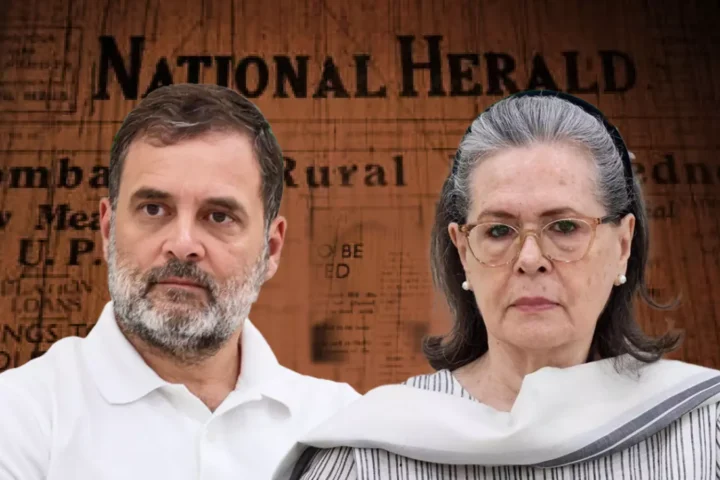
Congress Rahul Gandhi H Files voter fraud allegations has set off a political storm in Indian politics
After alleging that officials included nearly 25 lakh fake votes in the Haryana Election,
calling it one of the biggest cases of electoral fraud in recent history.
Gandhi made the claim during his digital campaign series “H- files”,
he described it as his investigation into how, according to him, people are stealing democracy through data manipulation.”
Gandhi accused the ruling Bhartiya Janta party (BJP) of deliberately inflating the state’s voter rolls to its advantage
He stated that out of roughly 2 crore registered voters in Haryana, around 12.5% were fake entries,
including 5.21 lakh duplicate names, 93,174 invalid addresses, and 19.26 lakh bulk voters.
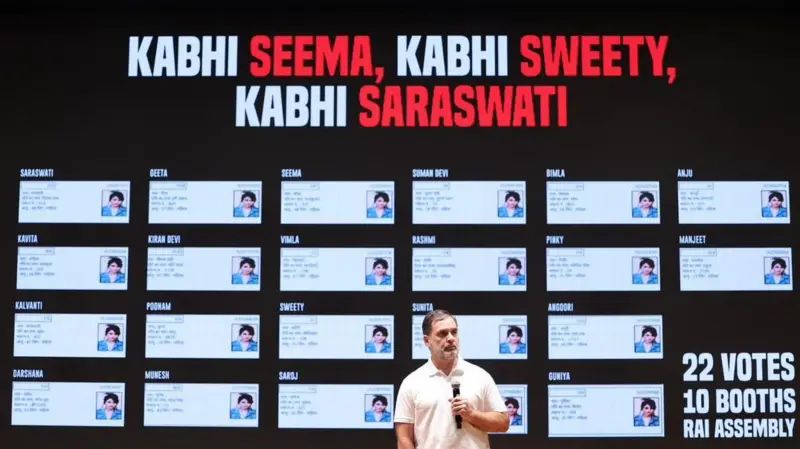
As evidence, he showed a voter list allegedly containing a single woman’s photograph
repeated 22 times under the different names such as Seema, Sweety, and Saraswati.
He further claimed that the image was actually that of a Brazilian model, used fraudulently in the database.
“This is not just voter fraud, It’s democracy theft”. This is “vote chori” and “sarkar chori”.
Gandhi said, adding that similar manipulations could take place in upcoming elections across India if the issue is ignored.
The election commission of India (ECI) responded strongly, rejecting the allegations as “unverified and misleading”.
The official clarified that Rahul Gandhi had not submitted any verifiable evidence
The election commission said Rahul Gandhi had not submitted any evidence through official legal procedures and confirmed that officials legal procedures and confirmed that officials reported no irregularities during the revision of electoral rolls.
The commission updates the voters list through a transparent process and invites public objections,
but only a handful of complaints were received in Haryana.
The ECI reaffirmed that the credibility of India’s electoral system remains intact,
emphasizing that “large scale duplication” is not supported by any data.
The political reaction was immediate and intense.
Haryana chief minister Nayab Singh Saini dismissed Rahul Gandhi’s claim as a “desperate attempt by a falling opposition to remain in the news”.
BJP leaders accused the Congress of spreading the information to undermine public
confidence in free and fair elections. On the other hand Congress spokesperson defended Gandhi’s stand,
stating that the data had been collected by party volunteers over several months and calling for a judicial probe
into what they described as “systematic election manipulation.” They argued that the issue goes beyond party politics,
questioning the security of the entire electoral database.Experts and political observers have expressed mixed views.
Independent analysts say that while voter duplication of inaccuracies are common in larger democracies due to migration, clerical errors, or delayed deletions,
Gandhi’s scale of accusation is unprecedented and would require extensive data verification.
Digital governance specialists pointed out that the de-duplication software used by the Election Commission,
Experts said that Election commission has not updated the data matching algorithm designed to identify repeated names for years, possibly allowing certain errors to persist.
However, they also emphasized that proving deliberate tampering demands digital audit trails and server-level access,
which only the Commission and Certified Auditors possess.
The controversy has revived an ongoing debate about electoral transparency and Data integrity in India politics.
Gandhi’s claims have amplified demands for an advanced voters verification system including AI driver and facial recognition tool,
biometric linking and real time cross verification with Aadhar and demographic databases.
experts argue that while these technologies could improve accuracy, they also raise privacy and data misuse concerns.
Despite the Election commission’s denial, the issue continues to dominate headline and political discussion nationwide.
Rahul Gandhi’s “H- Files” campaign has forced the Spotlight back on the credibility of the Indian electro process,
a cornerstone of the world’s largest democracy.
Whether his allegations lead to an independent investigation or remain a contested political narrative,
the Haryana election has become a crucial test of trust between
India’s institutions, political parties, and the People they claim to represent.