Delhi air pollution school winter break debate:
A Delhi founder’s viral LinkedIn post has started debate over the capital’s winter school calendar as the city chokes under hazardous air.
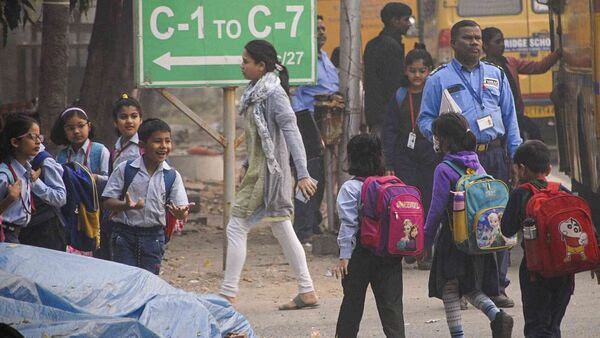
Akshay Verma, co-founder of fitness start of FITPASS, argued the Delhi’s traditional academic timetable fails children when pollution spikes force sudden School shutdowns
and he suggested flipping the long summer break to a long winter pause instead.
Verma wrote that while these three year old learns basics like holding a pencil one week,
the next week he must be taught why he can’t go to school because the air is “too poisonous”.
He called the stop-start routine “surreal” and said families who can afford it are already relocating temporarily to avoid the smog,
an option out of reach for most households.
The post has racked up thousands of reactions and sparked a public conversation about whether the school calendar should adapt to seasonal public health realities.
The post comes as Delhi’s air-quality deteriorated sharply this week, multiple monitoring stations recorded AQI readings in the “very poor”to “severe” range,
with city averages around the high 300s and pockets crossing 400. Authorities invoked higher level Graded response action plan,
(GRAP) curbs in recent days as smog blanketed neighbourhoods and visibility fell.
Health experts warn that such levels pose immediate risk for children, the elderly and people with respiratory conditions
Verma framed his proposal with a practical precedent . Hill schools routinely align vacations with Weather patterns,
he wrote, and Delhi, which has reliable seasonal pollution peaks each Winter,
could similarly shift academic break from summer to the months When air quality habitually collapses .
He argued that while heat can be mitigated inside the classroom, toxic cannot and empty classrooms
during peak pollution month amount to loss of instructional time for a generation.
Reaction on social media split between applause and practical scepticism. Parents and educators praised the idea’s logic and its child first orientation.
Others pointed to logistical hurdles such as synchronising examinations , aligning university calendars,
child care for working parents and the economic disruption for school and staff.
Commentators also noted the unequal impact, wealthier families who can travel or buy purifiers protect their children,
while poorer families face the health burden at home.
Experts say the suggestion has merit but would require detailed planning.
Schools boards and state education departments would have to redesign the exam timeline,
teacher training cycle and Mid year admission. Public health authorities would need to pair calendar shifts with long term pollution control
s such as stricter enforcement of GRAP measures, control of stubble burning in neighbourhood states,
tighter construction dust rule and transport interventions to make any new schedule meaningful rather than merely symbolic.
Recent government moves to enforce GRAP stage III illustrate the scale of the short term restrictions sometimes needed,
but they do not substitute for structural fixes
Policy makers have not formally responded to Verma‘s post, but the exchange highlights a widening public demand:
residents want solutions that go beyond episodic advisories and school closures. f
or many families,the debate has shifted from abstract “air quality” statistics to hard daily choices,
whether to send a coughing child to class, to buy an air purifier, or miss work to stay home with them.
As one commenter put it in reply to Verma that “Air quality is not just a statistic it’s shaping childhood and routines.”
If authorities consider calendar reform, experts should pilot the idea first,
perhaps with a few district or private school groups and rigorously track learning outcomes,
attendance, public health indicators and economic impact. Ultimately, shifting vacation will not cure Delhi pollution,
It may however, reduce immediate harm to children if paired with an enforceable plan to cut emission
until then Delhi‘s annual winter of smog will keep forcing families and educators to improvise around a recurring public health emergency.
(Delhi air pollution school winter break debate)