Delhi Pollution News Today: Air quality has once again become a pressing concern as the city battles its annual winter pollution crisis.
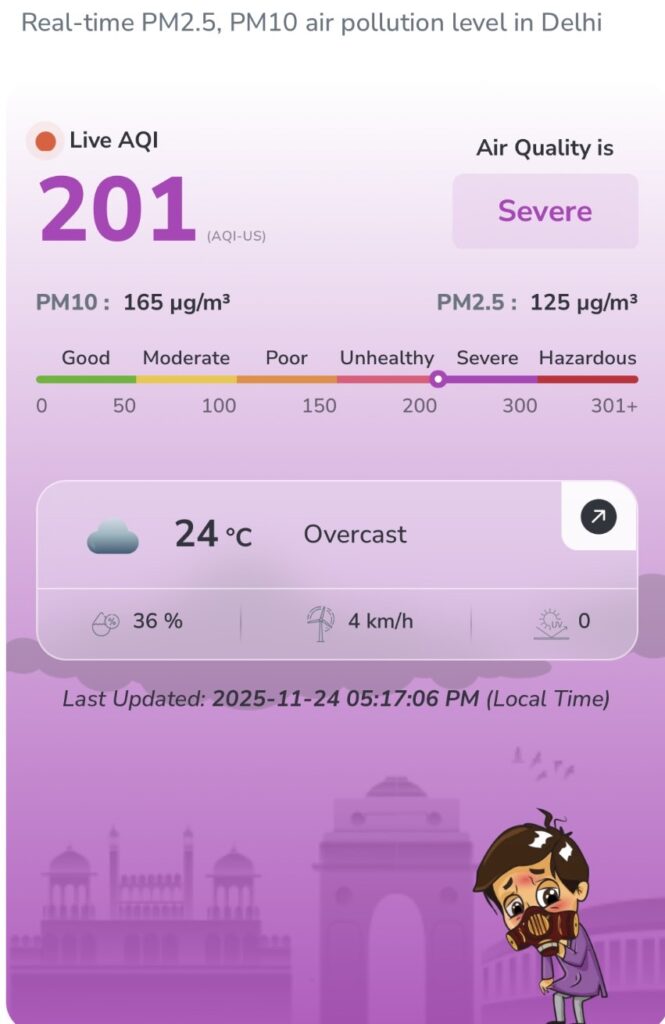
The situation has reached alarming levels, with the Air Quality Index (AQI) consistently hovering in the “severe” category.
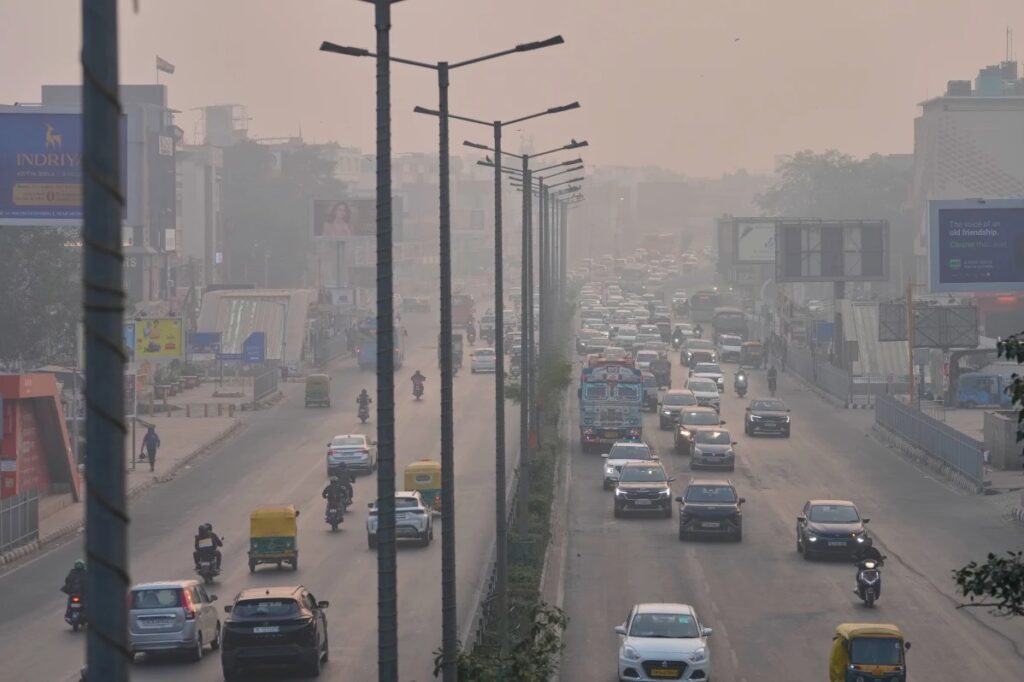
The winter months bring a perfect storm of conditions that trap pollutants close to the ground.
Cold temperatures, reduced wind speeds, and atmospheric inversion create a blanket effect that prevents harmful particles from dispersing.
This year’s pollution crisis is particularly concerning as multiple factors have combined to create some of the worst air quality readings we’ve seen.
Recent AQI data shows readings consistently above 400 in several parts of the city, placing Delhi’s air quality in the “severe” category.
To put this in perspective, an AQI between 0-50 is considered “good,” while anything above 300 is classified as “hazardous” by international standards.
The current situation demands immediate attention from both authorities and residents.
The search for solutions has intensified as people desperately look for the latest updates on pollution levels,
government interventions, and practical measures they can take to protect themselves and their families.
Delhi’s Current AQI: Latest Hourly and Morning Update
This morning’s AQI readings paint a grim picture across Delhi’s monitoring stations.
The overall city average has reached 420, marking it as “severe” on the pollution scale.
Evening readings yesterday showed a slight improvement to 380, but the overnight accumulation of pollutants has pushed numbers back up significantly.
Comparing today’s figures with yesterday’s data reveals a troubling pattern. While yesterday’s morning AQI stood at 395,
today’s 420 reading represents a 25-point increase, suggesting that pollution levels are worsening rather than stabilizing.
The most polluted zones today include areas that consistently rank among Delhi’s worst air quality hotspots.
These regions are experiencing AQI levels that exceed safe breathing standards by more than eight times.
Here are today’s top 5 areas with the highest AQI readings:
- Anand Vihar: 485 AQI (Severe Plus)
- Jahangirpuri: 468 AQI (Severe)
- Mundka: 452 AQI (Severe)
- RK Puram: 441 AQI (Severe)
- Punjabi Bagh: 438 AQI (Severe)
Understanding these pollution categories helps put the crisis in context.
The “Severe” category (AQI 401-500) means healthy people will experience reduced endurance in activities.
People with lung or heart disease should avoid outdoor activities. Everyone should avoid outdoor exercise and activities.
When AQI readings consistently stay above 400, it’s not just an environmental issue anymore – it becomes a public health emergency that affects every aspect of daily life.
Top Areas With Worst Pollution Levels Today
The geographical distribution of pollution across Delhi reveals interesting patterns that help us understand why certain areas consistently rank among the worst affected.
Today’s area-wise breakdown shows significant variations, with some neighborhoods experiencing pollution levels nearly twice as high as others.
Anand Vihar continues to top the list with PM2.5 concentrations reaching 312 µg/m³ and PM10 levels at 485 µg/m³.
This railway station area suffers from a combination of heavy vehicular traffic, construction activities,
and its location near the Delhi-UP border where industrial emissions add to the pollution load.
Jahangirpuri recorded PM2.5 levels of 298 µg/m³, making it the second-worst affected area today.
This densely populated residential area faces challenges from narrow roads that trap pollutants and limited green cover to absorb harmful particles.
Mundka, known for its industrial activities, shows PM2.5 concentrations of 289 µg/m³.
The presence of small-scale industries and its proximity to waste burning sites contribute significantly to its poor air quality.
RK Puram and Punjabi Bagh both recorded PM2.5 levels exceeding 280 µg/m³, well above the safe limit of 60 µg/m³ for 24-hour average exposure.
These areas remain consistently polluted due to several factors:
- Heavy traffic congestion during peak hours
- Limited wind corridors for natural air circulation
- High building density that traps pollutants
- Proximity to construction sites and industrial areas
- Inadequate green cover to filter air naturally
The contrast is stark when you compare these readings with areas like Lodhi Road or Teen Murti, which typically record AQI levels 50-100 points lower due to better urban planning and increased green spaces.