

For more than ten years, Europe has responded to migration by building walls instead of solutions. Under the policy framework often described as “Fortress Europe,” governments promised stronger borders, public safety, and control over irregular migration. What emerged instead was a system marked by humanitarian abuse, political radicalization, and policy failure.
Rather than reducing migration, Fortress Europe made it more dangerous, more chaotic, and more profitable for criminal networks.
Deterrence as Policy
European leaders chose deterrence as their main policy tool. Borders were militarized, asylum procedures restricted, and migration control increasingly outsourced beyond EU territory.
Agreements were signed with authoritarian governments and armed groups in countries such as Libya and Türkiye, shifting responsibility away from Europe’s legal obligations.
At the same time, humanitarian rescue efforts in the Mediterranean were criminalized.
NGO vessels faced seizures, legal harassment, and prolonged port bans.
According to the International Organization for Migration (IOM), more than 28,000 people have died or gone missing in the Mediterranean since 2014, making it one of the deadliest migration routes in the world.
These measures did not stop people from moving. Conflicts in Syria, Sudan, Afghanistan, and Ukraine, along with climate-driven displacement and economic inequality, continued to force people from their homes.
When legal pathways closed, migrants turned to riskier routes.
Normalizing Border Violence
The Mediterranean has become one of the deadliest migration routes, with tens of thousands reported missing or deceased since 2014. Many others disappeared without records or graves. European institutions increasingly described these deaths as unfortunate but unavoidable outcomes of “border management.”
This framing normalized violence.
Pushbacks at land and sea borders — documented by organizations such as Human Rights Watch and Amnesty International — became routine, despite violating international refugee law.
Detention camps in Greece and Italy grew overcrowded, while asylum backlogs left people in legal limbo for years.
Fortress Europe did not produce order; it produced invisibility.
Migration as an Industry
Fortress Europe also created a multi-billion-euro migration control industry.
Private security companies, surveillance technology firms, biometric data contractors, and detention operators expanded rapidly, funded by EU border budgets.
At the same time, smuggling networks flourished. Demand for movement never disappeared — only safe options did.
When states blocked lawful routes, criminal intermediaries stepped in to fill the gap.
Governments then pointed to the resulting disorder as proof that migration was “out of control,” justifying even harsher policies. This feedback loop sustained itself politically and financially.
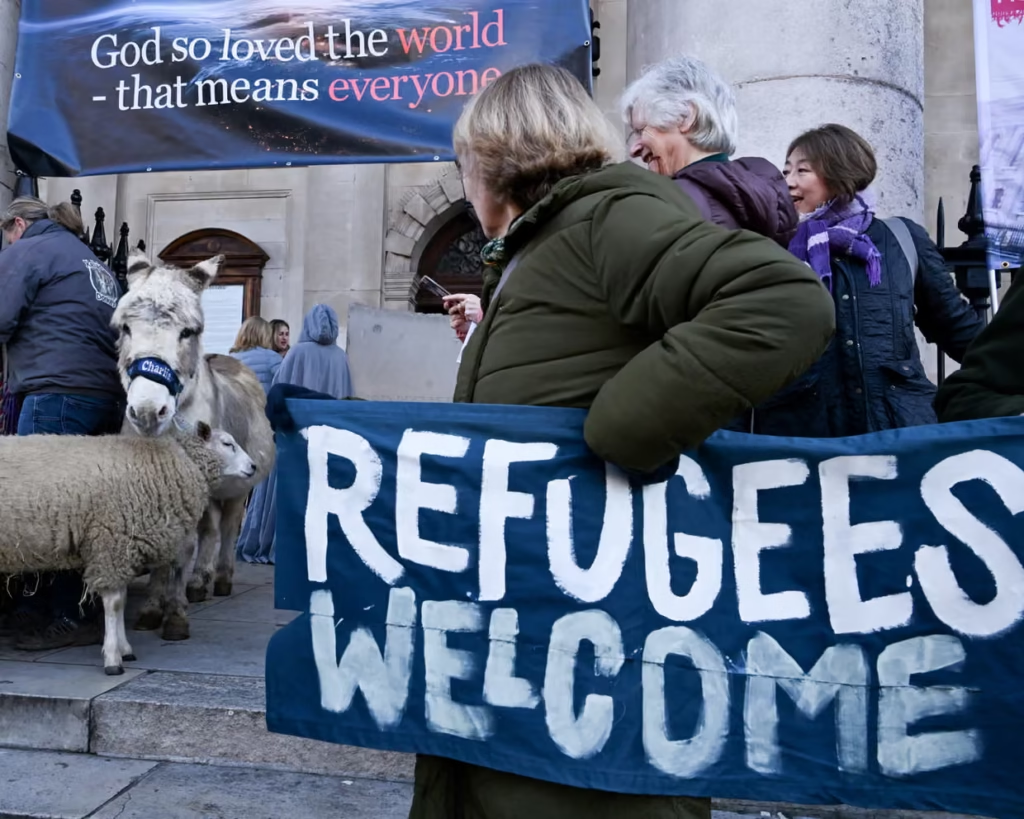
Political Consequences Inside Europe
As migration was framed as a security threat, far-right parties gained electoral ground across Europe.
Instead of confronting misinformation, mainstream political parties adopted far-right language and proposals, hoping to recapture voters.
The strategy backfired.
By repeating xenophobic narratives, centrist parties legitimized them. Migrants became symbols of fear rather than individuals with rights.
Public debate shifted from evidence to emotion, and cruelty became normalized policy.
Research from the European Council on Foreign Relations shows that restrictive migration policies rarely reduce public anxiety — they amplify it.
Failure on Its Own Terms
Even judged by its own objectives, Fortress Europe failed.
It did not deliver stability. It strained relations between EU member states, undermined the right to asylum, and weakened Europe’s global credibility as a defender of human rights. A continent that once claimed moral leadership now routinely defends pushbacks, externalized detention, and collective punishment.
Migration flows continue — only at greater human cost.
A Different Path Is Possible
The next decade does not have to repeat this failure.
Europe has alternatives. Expanding safe and legal migration routes would reduce deaths and weaken smuggling networks. Fair responsibility-sharing among EU states would ease political tensions. Investment in integration — housing, language access, employment — would strengthen social cohesion rather than erode it.
Addressing root causes such as conflict and climate displacement requires long-term cooperation, not the use of development aid as political leverage.
This crisis is political, not inevitable.
Fortress Europe was built by design — and it can be dismantled by design.
The last decade showed what fear produces.
The next can demonstrate what solidarity, realism, and humanity are capable of achieving.
(Fortress Europe migration policy)


- Aviation
- Aviation News
- Bollywood legal news
- Business and economy
- Crime / Scams
- current affairs
- Cybersecurity / Technology News
- Daily Updates
- Delhi High Court News
- Delhi news
- education policy
- Entertainment
- Global Affairs
- global economy
- Health / Medical News
- india news
- Indore News
- international news
- law and policy
- Maharashtra politics
- Media and society
- national news
- News and Current Event
- politics
- Politics and culture
- Politics and Law
- society and culture
- sports
- Technology / Social Media News
- Technology & Society
- Trending and Politics
- Trending and Politics
- Trending and technology
- Uncategorized
- Weather / Natural Disasters
- world news
- World News / International News
- Trump Says War with Iran Could Last Four Weeks History Disagrees
- From Kerala to Keralam: Heritage Move or Hidden Agenda?
- IIT Bombay Security Alert: College Dropout Arrested After Live Bullets Found in Hostel
- The Arrest of Andrew Mountbatten-Windsor: A Deep Look at the UK Scandal Rocking the Royal Family
- Italy Cricket Team’s T20 World Cup Hero Crishan Kalugamage Once Worked at a Pizza Shop







[…] world news […]