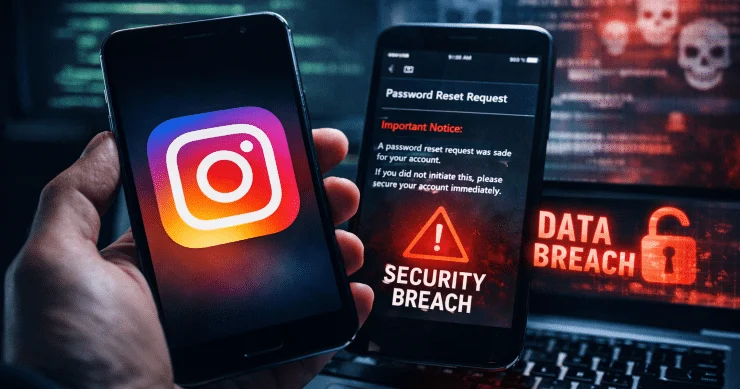
Instagram data leak 1.75 crore users: Imagine scrolling through your Instagram feed one evening, liking photos, watching reels, and sharing stories with friends.
Now imagine waking up to find out that your personal data — the stuff behind your username might be out there somewhere, in the hands of people you’ve never met.
That’s the mood spreading online after reports about a massive Instagram data exposure.
According to multiple reports, information tied to about 1.75 crore Instagram users has surfaced on the internet.
That’s 17.5 million people — more than the entire population of many countries.
And it’s not just usernames. Things like email addresses, phone numbers, and other account details were reportedly included in this dataset.
For millions of Indians, this news hit close to home.
Let’s pause for a moment and think about that number again. 1.75 crore accounts.
That’s huge. It’s bigger than the entire Twitter user base in some countries. So when you hear something like this, your attention naturally spikes.
You start wondering, Is my account part of this? What information of mine is out there? And those questions are valid.
Here’s the thing. Instagram, with its endless scroll of photos, videos, and stories, doesn’t always feel like a place where serious things happen.
But beneath the surface, it carries a lot of personal information. Email. Phone number.
Sometimes even date of birth. And if that data leaks, well, it can show up in ways that make you uncomfortable spam texts, unknown phone calls, or worse.
Now, I know what you might be thinking: “This happens all the time online. Another leak.
Big deal.” But hear this — these aren’t just random numbers floating in some undocumented corner of the web.
Based on how cybersecurity researchers described it, this data was compiled in a way that made it easy for hackers to access and download.
That’s not accidental. It means someone put effort into collecting and organizing it.
What worries people most is how easily this dataset could be misused.
Let’s say someone gets hold of a phone number paired with a name and an email address.
That’s enough for targeted spam, scams that sound deceptively real, or even identity theft.
Have you ever gotten a message that looked way too personal but wasn’t from someone you know?
That’s the danger we’re talking about.
Instagram responded by saying they’re looking into it and working to secure accounts.
They also mentioned that there’s no clear evidence that passwords were exposed which is a small relief.
Still, even without passwords, the information that leaked is sensitive enough to cause stress for millions of people.
At the heart of this story is a simple truth: we trust these platforms with our lives.
We share celebrations, heartbreaks, travel plans, and daily routines.
We connect with old friends, meet new ones, and put ourselves out there.
And yet, we rarely stop to think about what happens to the data behind those accounts.
If your email and phone number are floating around on the internet, how safe do you feel?
It’s one thing to share photos with friends. It’s another to have your contact details sitting in a database that you never agreed to share.
And it’s easy to forget all this when you’re double‑tapping heart emojis or watching a funny reel.
Here’s another question worth asking: How much control do we really have over our own information?
We upload dozens of photos a month and follow influencers, interact with brands.
Yet, when something like this happens, the first thing most of us do is check our accounts to see if everything still “looks normal.”
That’s a strange reality — normal has come to mean “nothing visibly broken,” even when something deeply personal might be compromised.
Cybersecurity experts suggest a few steps right now: change your passwords, turn on two‑factor authentication, and be cautious about suspicious messages.
That advice is practical. It’s real. But it also feels like putting a Band‑Aid on a deep cut.
The bigger issue is how platforms handle data, and how easily it can move from secure servers into public access.
The emotional response here isn’t just fear. It’s a mix of frustration and betrayal.
We use these services daily. They shape our conversations, our relationships, our sense of community.
And when something goes wrong, it doesn’t just affect accounts — it affects the very way we interact online.
But there’s also resilience in moments like this. Already, users are checking their settings, talking to friends, urging family members to tighten security.
There’s a collective sense of looking out for one another, even amid uncertainty.
Maybe that’s the silver lining: people becoming more aware, more proactive, and more informed about their digital footprint.
So what happens next? Time will tell. Instagram will investigate. Experts will parse the details.
Users will change passwords and update settings. And life online will continue, as it always does.
But here’s the real takeaway: in a world where so much of our identity plays out on screens, the exposure of personal data isn’t just a technical problem.
It’s a human one. It hits at the heart of trust — the trust we place in platforms that feel like a part of our everyday lives.
(Instagram data leak 1.75 crore users)


- About Us – Facts Beyond Border (FBB)
- Contact us
- Declaration
- Privacy Policy
- Term and conditions
- Write For FBB
For more updates visit FBB Daily