Mumbai BMC Election 2026: The 2026 Brihanmumbai Municipal Corporation election gave us numbers that look clear at first glance.
But the reality is far more complicated. The BJP and Eknath Shinde Shiv Sena worked together, and yes they have just enough seats to take charge. Just enough.
Only four seats above the majority line. That’s a margin so slim that it doesn’t feel like full control.
Every seat, every elected corporator, suddenly carries enormous weight.
This isn’t just politics as usual. The narrow victory has made the BJP-Shinde camp happy, but it has also stirred unease on the other side.
Leaders there warn of challenges ahead. And when you think about it, why wouldn’t they?
Mumbai is India’s financial heart. How the city is governed affects not just local life but business, investment, and even state politics.
Looking at the numbers, the BJP-Shinde alliance managed to claim enough seats out of 227 to form the civic body.
On paper, it’s a win. But in practice, this kind of slender majority can feel fragile.
One defection, one disagreement, one misstep, and the balance could tilt. That’s the tension in Mumbai right now.
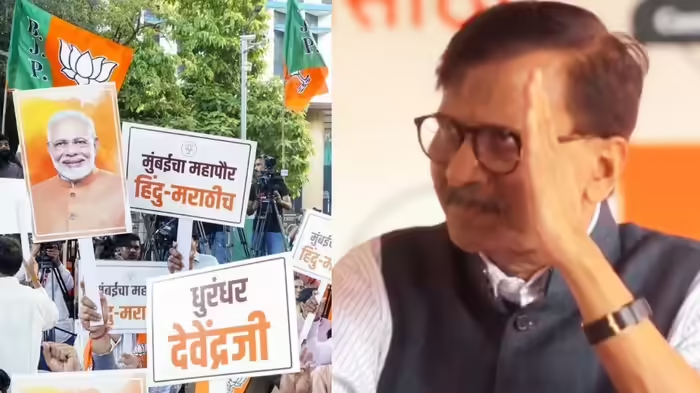
Sanjay Raut, the leader of Shiv Sena (UBT), didn’t wait to voice his thoughts.
He made it clear that this isn’t really a victory in his eyes. The alliance’s slim margin, he argued, reveals weaknesses.
When the gap is so narrow, he says, decision-making becomes tricky.
Party members could leave, or demands could get negotiated constantly.
Stability is not sure. And honestly, can a government with such a narrow base really focus on running a city as complex as Mumbai?
Raut didn’t just talk numbers.
He invoked history and reminded everyone of the 2022 Shiv Sena split and called out the Shinde faction’s loyalty.
He used the term “Jaichand,” a loaded word that implies betrayal from within.
Suddenly, the conversation shifted from counting seats to questioning who has the moral right to lead.
People started thinking about legacy, about what Shiv Sena stands for, and what it has meant to Mumbai over the years.
The BJP and Shinde camp, on the other hand, see the result differently. They read it as proof that voters are willing to try something new.
For decades, the undivided Shiv Sena held Mumbai. Now, that control has slipped, and the BJP views this as a foothold in a city whose influence stretches across Maharashtra and even beyond.
The win is more than symbolic; it carries political and economic weight.
Yet, the narrow margin raises serious questions.
Can a government with such a thin majority actually get things done?
The BMC oversees an enormous budget and is responsible for essential services—hospitals, buses, roads, sanitation, flood management.
If internal disagreements creep in, the government could stall projects, slow down basic services, and disrupt daily life for Mumbaikars
This is not a theoretical worry—it’s tangible for millions of people.
The voter mood shows this divide clearly. In several wards, winners edged out losers by just a handful of votes.
Some voters chose BJP for promises of better governance and infrastructure.
Others stuck with UBT candidates because of long-term connections, familiarity, and shared culture.
Opposition parties still command considerable support, even in areas they didn’t win, and this makes the political landscape even more unpredictable.
Fragmentation among opposition parties also played a role.
Even though UBT performed strongly, the spread of votes across multiple parties prevented a decisive counter-majority.
Had alliances been tighter, the story might have been very different.
This is a lesson political strategists won’t forget, especially with state and national elections on the horizon.
And yet, beyond politics and numbers, there’s the human side. For ordinary citizens, this election isn’t about rhetoric or rivalry.
It’s about roads that don’t flood, schools that function, buses that run on time, and hospitals that are accessible.
The city’s challenges crowding, high cost of living, monsoon floods—don’t wait for politicians to settle their disputes.
A government that is constantly worried about internal politics will struggle to deliver.
So, this election is both a win and a warning.
The BJP-Shinde alliance has emerged victorious, but the slim majority demands careful cooperation.
If they work together, this margin could be enough. If not, even this “win” could unravel.
For the opposition, the message is equally clear: unity, strategy, and clarity will be critical for the next round.
And for Mumbaikars, the lesson is obvious—power alone doesn’t guarantee progress. What matters is whether the city can be run efficiently, fairly, and responsively.
As celebrations fade and the political noise settles, the real story will be written in the BMC offices.
Can the government deliver, or will the narrow margin become a source of instability?
In Mumbai’s politics, even a victory can feel like a warning, and this is one of those moments.
(Mumbai BMC Election 2026)