India’s higher education system stands at a crossroads, and the UGC Act 2026 has pushed it there.
Introduced as a reform for equity and inclusion, the new regulations under the UGC Act aim to change how universities handle discrimination.
But instead of consensus, the policy has triggered nationwide protests, legal battles, and deep political division.
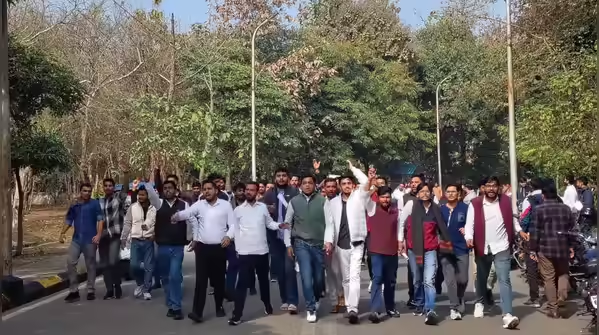
What began as a push for justice has turned into one of the most intense education debates in recent years.
Why the UGC Act Exists in the First Place
Indian campuses have never been socially neutral spaces. Caste, class, gender, language, and economic background often shape access to opportunity from classrooms and hostels to internships and placements.
For decades, students from marginalised communities have spoken about subtle exclusion, humiliation, and institutional silence.
Some cases became national movements, others remained invisible but devastating.
The UGC Act 2026 emerged from this history. Policymakers framed it as a structural correction, not symbolic reform.
Instead of optional guidelines, the law creates enforceable obligations.
Institutions are no longer asked to “try” being inclusive — they are legally required to act.
What the New UGC Act Changes
The updated provisions under the UGC Act focus on accountability rather than intention. Every university and college must now:
- Establish anti-discrimination and equity cells
- Appoint Equity Officers
- Create formal grievance redressal systems
- Define discrimination across caste, religion, gender, disability, and social background
- Face penalties for non-compliance, including financial consequences and loss of institutional recognition
This marks a major shift. Inclusion moves from policy language to legal duty.
The message is direct: fairness is no longer optional governance — it is mandatory structure.
Why Campuses Are Protesting
Despite its goals, resistance has grown fast.
Students across states argue that the law feels legally vague and open to misuse.
Many fear that the UGC Act 2026 lacks clear safeguards against false complaints and subjective interpretation.
There is also a deeper emotional concern.
Students and teachers worry campuses may transform into bureaucratic spaces of surveillance rather than learning where fear replaces dialogue, and documentation replaces discussion.
Faculty members fear administrative overreach and loss of academic autonomy.
Smaller colleges face practical challenges.
Many lack staff, funding, and infrastructure to implement complex regulatory systems.
Without support, compliance risks becoming chaos, not reform.
From Campus Debate to Courtroom Battle
The conflict has now moved beyond student protests.
Legal petitions have challenged the constitutional validity of the regulations, arguing that parts of the UGC Act violate principles of equality and due process.
The Supreme Court has stayed implementation for now, keeping older guidelines in force until detailed hearings conclude.
Politics has further sharpened the divide. Some leaders defend the reforms as long overdue justice for historically excluded communities.
Others argue the law risks deepening social fault lines and turning campuses into ideological battlegrounds.
The Real Question India Must Answer
The real issue is not whether discrimination exists it does.
The question is whether the UGC Act 2026 addresses it in a way that builds trust instead of fear, protection instead of polarization.
Strong laws can reform broken systems.
But poorly designed systems can fracture institutions.
If inclusion feels imposed instead of earned, it creates backlash.
If accountability feels punitive instead of corrective, it creates resistance instead of reform.
Higher education shapes a nation’s future leadership, ethics, and social values.
The UGC Act now stands as more than a regulation it has become a national test of how India balances justice with freedom, reform with dialogue, and law with trust.
This debate will not end in courtrooms alone.
It will unfold in classrooms, hostels, student unions, staff rooms, and campus corridors where the real meaning of equity is lived, not legislated.