Thousands of Indian professionals in US work permit change may soon face job uncertainty as the U.S. Department of Homeland Security, (DHS) ends automatic extensions of Employment Authorization Documents (EADs)
The new role effective October 30, 2025, eliminates the 540 day grace period that previously allowed foreign workers to continue working
while their EAD renewal applications were pending.
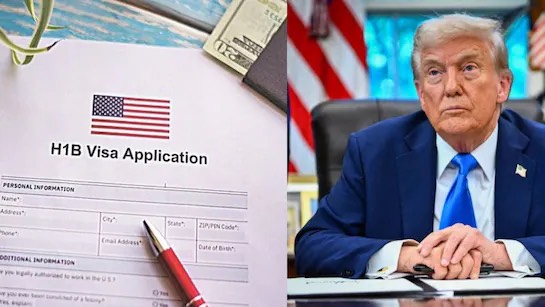
indian professionals in US work permit change under Trump administration affecting H- 1B Visa holders
Under the earlier system, employees whose work permits expired could legally continue working if they filed their renewal application on time.
Now, with that automatic extension gone, every applicant must stop working immediately after their ED expires,
unless the US citizenship and immigration services (USCIS) approves the renewal beforehand.
The single administrative change could derail the lives of thousands of Indian nationals,
especially those on H-4 EADs (spouse of H-1B visa holders), STEM OPT permits, and employment based green card applicants.
Indian professionals form the largest share of America’s skilled migrants workforce,
with nearly 75% of H-1B visa holders coming from India, according to U.S. Government data.
The tech and healthcare sector, which rely heavily on Indian talent, are brazing for disruptions.
Employers now must verify that each foreign worker holds an approved and valid EAD —mere proof of filling will no longer suffice.
Companies fear potential project delays Talent gaps, if renewals, don’t clear in time.
Immigration, experts and attorneys have sharply criticized the move.
They argue that the DHS has made the change without addressing the root problem— USCIS processing delays.
In many cases, EAD renewals already take 4 to 6 months.
Without automatic extension, even minor administrative backlogs could push legal workers into employment overnight.
Attorney Cyrus Mehta, a leading immigration expert,
told U.S. media that this decision “creates needless panic among law-abiding professionals”
and will disproportionately hurt skilled immigrants who contribute significantly to the American economy
He warned that “removing the automatic extension efficiency and rewards red tape.”
Indian families in the U.S. are feeling the pressure.
Many households rely on two incomes,
and a sudden loss of One could disrupt everything—from rent and tuition payment to Visa status.
For H-4 spouses, mostly women, the fear of being forced to leave the work force looms large. “I filed my ED renewal in August.
It’s still pending if the rule start before it, I will lose my job”,
said Priya Sharma a software analyst in Dallas, in a post on LinkedIn that gained thousands of reactions.
The Trump administration, which returned to power this year, defends the policy as a “security and accountability measure.”
DHS officials claim that ending automatic extensions ensure that “only fully vetted individuals remain employed.”
However, critics see it as part of a broader pattern of tightening, immigration channels
and discouraging foreign workers under the banner of protecting American jobs.
This isn’t the first such move. Earlier in 2025, the administration introduced a controversial $100,000 supplemental fee for H-1B visa applicants,
sparking backlash from tech companies and immigration lawyers alike.
Together, these changes have revived concerns that the US is becoming a less welcoming destination for skilled talent,
especially from India.
Experts advise Indian professional to act proactively.
USCIS allows EAD renewal applications to be filed up to 180 days before expiration.
Applicants should track their cards expiry date carefully and submit renewal forms as early as possible.
Employers should implement a digital monitoring system for Visa dependent staff to prevent unexpected work interruptions.
The ripple effect could also hit India. With many professionals reconsidering their future in the U.S, India could see a return of high- skilled migrants.
A form of reverse brain drain. Domestic companies, especially in Bengaluru, Hyderabad and Gurugram may benefit from a sudden influx of globally trained professionals.
Yet, for now, the tone among Indian professionals in US work permit change is one of anxiety.
The end of automatic work permit extension introduces a new layer of predictability in an already complex immigration system.
The American dream,For many, now depends not just on talent or opportunity-
but on how fast a piece of paperwork move through the USCIS queue