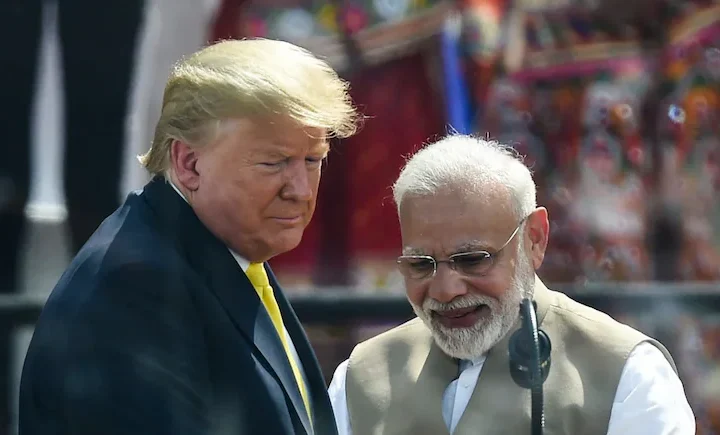
“I am good at solving wars,” declared Donald Trump with his signature confidence, and now he says his next mission is to end the Pakistan Afghanistan conflict.

The former US president known for turning diplomacy into stage show has once again put himself at the centre of global tension, but can Trump really bring peace to one of the world’s most volatile borders or is this just another headline grabbing boast?
The viral statement That Shook Global Politics
Speaking about Air Force, one Trump told reporters
“This will be my eighth war that I have solved. I hear there’s a war going on between Pakistan and Afghanistan. I’ll take care of it when I get back”
Within hours, the international Media lit it up. hashtags like #TrumpSolvedWars #PakistanAfghanistan and #TrumpPeacemission began trending across X (formerlyTwitter) from Washington to Islamabad,
Everyone had the same question: is Trump serious or just selling another story?

The Durand line, the rugged border that separates Pakistan and Afghanistan has long been a flashpoint, but this time,it’s different, the violence has escalated sharply.
- deadly clashes erupted this week, leaving dozens, dead on both sides
- Pakistan accused Afghan Based militants of launching cross-border attacks
- The Taliban government denied involvement and accused Pakistan of provocation
- border crossings like Torkham and Chaman- Vital trade arteries- are now shut.
The stand-off has frozen commerce, displaced families, and once again reminded the world that peace in South Asia remains fragile.

Trump’s belief that he can “end wars” is part ego, part strategy. During his presidency, he took credit for several global ceasefires: from the Israel- UAE peace deal to temporary Halts in India- Pakistan and Israel Hamas hostilities.
He often framed his diplomacy as a simple “deal, making”. To him every conflict is a negotiation, waiting for a closure.
But experts warn: Pakistan and Afghanistan are not real estate rivals : They are nuclear-adjacent nations with decades of mistrust, tribal politics and militant networks involved. Any peace. Here would need deep diplomatic groundwork, not just charisma.

The Challenges Ahead
Trump‘s claim that he can mediate peace between Pakistan and Afghanistan sounds bold.
but the road ahead is full of serious obstacles.
The first and biggest challenge is the Taliban control over Afghanistan. Since taking power in 2021.
The Taliban has governed with a strict and often unpredictable stance. Their relationship with Pakistan has been inconsistent- at times cooperative.
but often tense, especially when it comes to cross-border militant activity.
Next comes, Pakistan security concern, Islamabad, repeatedly accuses Afghanistan of allowing militant groups like Tehreek- e- Taliban Pakistan (TTP) to operate from its soil and launch attacks inside Pakistan.
Without solid guarantees on this issue, Pakistan is unlikely to trust any peace. No matter who brokers it
Then there are regional power dynamics. South Asia is a geopolitical chessboard involving India, China, Iran, Russia, and the United States.
Each of these countries has deep strategic interest in the region. for Trump or any external mediator.
Balancing these competing priorities would be an enormous diplomatic challenge.
Another major obstacle is the deep historical distrust between Pakistan and Afghanistan.
Both countries have accused each other of interference, betrayal and broken promises over the years.
Countless Peace talks have failed because of the mistrust- and it won’t vanish just because of one high profile negotiation.
So clearly for Trump to truly “Solve” this war, he’d have to handle Taliban unpredictability, Pakistan security, fear and the heavy influence of regional power- all while rebuilding decades of broken trust between two nations that have rarely seen eye to eye.
The geopolitical Ripples of Trump’s claim
When Trump speaks, the world listens not necessarily because of his diplomacy, but because of his unpredictability, his claim that he can “solve” the Pakistan, Afghanistan conflict has set off a ripple across the diplomatic circle from Washington to Doha.
Analysts believe Trump could pressure regional leaders who are revisiting the growing border tensions, which have already caused trade halts, cross-border shelling and humanitarian scare.
But while some see this as an opportunity for renewed dialogues, others fear it could further complicate the situation if handled with Trump’s tradeMark impulsiveness.
Pakistan’s reaction: “we don’t need external mediation”
Sources close to Islamabad foreign ministry suggested Pakistan is not thrilled by Trump’s self- assigned role as a “Peace Broker” officials reportedly view the situation as a bilateral issue, not an international one.and any third-party involvement, especially from Washington could be seen as interference.
However, behind closed doors analysts admitted that Pakistan patience is wearing thin. Border attacks blamed on Afghan based militants have become frequent,and Pakistan’s military has been on high alert along the Khyber and Balochistan regions.
“Trump’s entry into this discussion may not be welcome officially,” said a senior defence analyst, but it might still push both sides to take diplomacy more seriously.”
Afghanistan stand: focus on respect, not power”
The Taliban led Afghan government, meanwhile, maintains that Pakistan is provoking unnecessary conflict by using force instead of dialogue. Kabul insists that Afghan forces are defending their territory and that any foreign “intervention”- including Trump’s could inflame nationalist sentiment.
For the Taliban, whose international legitimacy remains fragile. Trump’s attention is both a risk and an opportunity.
If Trump truly engages diplomatically, it could bring global recognition, but if he uses his usual hardline rhetoric, it might backfire pushing Afghanistan further away from Western influence.
Could Trump’s deal making actually work?
Trump’s belief in his own ability to end war, come from his transactional style of diplomacy during his presidency of an approach to global conflicts like business deal, short meeting, personal charisma, and public showmanship.
He famously took credit for:
- The Abraham accords between Israel and Arab nations
- Temporary ceasefires between Israel and hamas
- Deescalation movements between India and Pakistan after the Pulwama Balakot crisis
But diplomacy in South Asia is a different beast altogether.
Unlike state to state negotiation.
This conflict involved militant networks, tribal loyalties and deep rooted political grievances. It is not a boardroom.
It’s a battlefield shaped by decades of bloodshed.